REVIEW · ALHAMBRA TOURS
Guided tour to Alhambra with Generalife, Alcazaba and Carlos V
Book on Viator →Operated by Granada Turismo y Ocio · Bookable on Viator
One walk. Big feelings. This guided Alhambra route gives you the defensive story first, then the poetry of the Generalife gardens and their water channels. You’ll get clear explanations of how the palatine city worked, why certain towers mattered, and what changed after the Christian conquest. It’s also a smart way to see major pieces of the complex in about two hours without getting lost.
I especially love how the tour mixes viewpoints and palace details. The Torre de la Vela stop puts Granada and the Albayzín on your radar right away, and the Generalife patios (like Patio de la Acequia) show how the Nasrid court controlled water, shade, and comfort. The one drawback to consider is timing: the tour is around 2 hours, and if your schedule is tight, delays can matter. Build in some buffer, because the site is busy.
In This Review
- Key highlights you’ll actually feel during the tour
- A guided route that hits the Alhambra’s power, water, and palatial life
- Meeting point and where your walk ends
- Stop 1: Alcazaba and the climb to Torre de la Vela
- Stop 2: Palace of Carlos V and why facades matter
- Stop 3: Calle Real de la Alhambra, the covered spine of the city
- Stop 4: Generalife on Cerro del Sol and its water-and-garden mindset
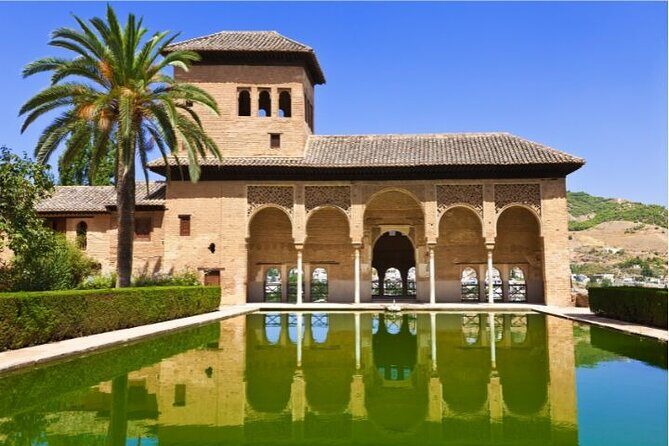
- Stop 5: Palacio El Partal’s portico, pool, and garden punctuation
- Price and ticket value: what you’re really paying for
- Timing tips: the 10:30 slot and how to handle real-world delays
- Who this tour suits best (and who should think twice)
- Should you book this Alhambra tour?
- FAQ
- What is the duration of the tour?
- Is the tour offered in English?
- Which areas of the Alhambra are included?
- Are any tickets included?
- Where do I meet the guide?
- Where does the tour end?
- Is an audio system included?
- How big are the groups?
- Is it suitable for people with reduced mobility or strollers?
- Can I cancel or change my booking?
Key highlights you’ll actually feel during the tour

- Alcazaba viewpoints from Torre de la Vela: you’ll see Granada, the Albayzín, and the Vega de Granada while learning the tower’s role.
- Carlos V explained in context: a 16th-century stop that helps you connect facade details to the building’s meaning.
- Calle Real in one continuous storyline: covered public areas, Christian modifications, and Nasrid ruins in the same sweep.
- Generalife patios with the water logic: orchards, labyrinth gardens, and specific courtyards like Patio de la Acequia.
- Partal Palace as a quick reset: portico, pool, and gardens to break up the day’s walking.
A guided route that hits the Alhambra’s power, water, and palatial life
This is a focused, English-guided tour of the Alhambra area that runs for roughly 2 hours. It’s designed for people who want the “how it all fits together” feeling, not just postcard views. With a small group size (up to 30) and an audio system, you can usually keep up even when the route compresses near busy entry points.
What makes this itinerary work is the order. You start with the Alcazaba, the military heart of the palatine city. Then you move to the Palace of Carlos V, which helps you understand what changed when later rulers reshaped the site. After that, you walk along Calle Real, the Alhambra’s public spine, before finishing with the Generalife, the hilltop retreat known for gardens and orchards.
You’ll be walking, but it’s not a marathon. It’s more like a sequence of “aha moments,” each stop adding a piece: defense, authority, daily life and craftsmanship, and finally the landscape that supported comfort and status.
You can also read our reviews of more guided tours in Granada



Meeting point and where your walk ends

You meet at the Alhambra Meeting Point, at the Tienda de Souvenirs y Alhambra tours, P.º de la Sabica, 1, Local, Centro, 18009 Granada. That’s also listed as the ticket redemption point, so it’s one less step to worry about.
The tour ends next to the Palace of Charles V (spelled Palacio de Carlos V in the tour description), at C. Real de la Alhambra s/n. This matters because you can plan your next move on-site. Transfer is not included, so if you’re staying in the area, you’ll appreciate that you’re released right where more exploring makes sense.
If you’re using public transit, the meeting area is described as being near public transportation, which is handy on busier days when taxis can get slow near the complex.
Stop 1: Alcazaba and the climb to Torre de la Vela
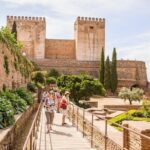
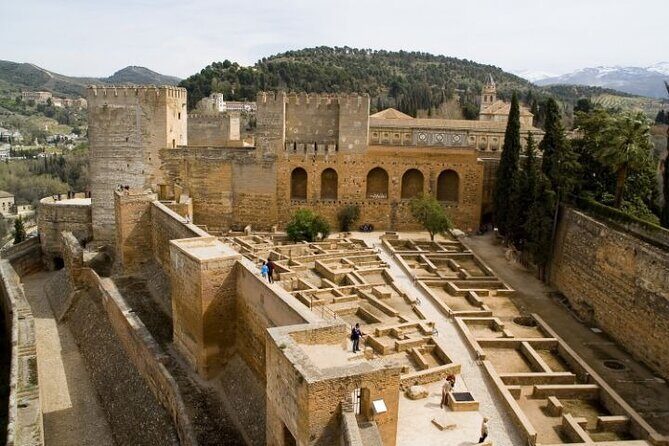
The Alcazaba portion is where the tour starts teaching you the Alhambra’s logic as a defended city. You’re not just touring pretty walls here. You’ll get explanations of the defensive structure of the palatine city—how it was organized to protect rulers, supplies, and residents.
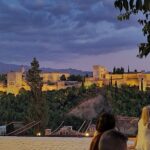
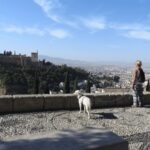
Then you’ll go up to the Torre de la Vela. This is a real payoff stop: it’s your big visual reset over the city of Granada. You’ll enjoy views of Granada, the Albayzín, and the Vega de Granada, while your guide explains what the tower did and what happened with it during the Christian conquest.
After the main viewpoint, you continue through quieter spaces inside the defensive zone, including the Jardín de los Adarves and the Puerta de las Armas. This is also where the tour feels well paced: you get one main “wow” view, then you shift into explanation mode again, so it doesn’t turn into a sprint of only climbing.
Practical note: even if the total tour is only two hours, the Alcazaba climb means you’ll want comfortable shoes and a plan for sun or wind. Granada can feel mild until you hit the open viewpoint areas.
Stop 2: Palace of Carlos V and why facades matter
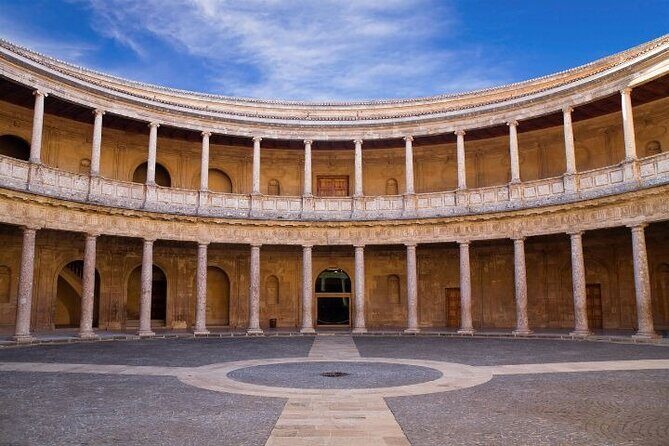
Next comes the Palace of Carlos V, a 16th-century building inside the Alhambra complex. Your stop here is shorter, but the goal is to help you look at it correctly.
You’ll get an explanation of the facades and the main courtyard, plus context about the building’s construction and symbols. It’s useful even if you don’t plan to go deep into the museums in this building. The guide also points out where the museums are located, so you can decide later whether you want to tack on extra time.
This stop is important for understanding the Alhambra as a layered site. Even if your heart is with the Nasrid era, the Carlos V architecture is part of the story of how later rulers reworked and reinterpreted the space.
Time-wise, you’re at this stop about 10 minutes. That’s not enough to “finish” the building on your own—but it’s enough to help you walk in with better eyes.
Stop 3: Calle Real de la Alhambra, the covered spine of the city
Calle Real is the long, public-facing corridor idea of the Alhambra—the part where you can sense the city layout. This part of the tour focuses on how the complex operated as a city, not just as isolated palaces.
One thing I like about this section is the mix of eras. You’ll get commentary about Christian modifications, including the church of Santa María de la Alhambra and the convent of San Francisco. The tour also notes that the convent is currently used as a national hostel, and it mentions it as the burial place of Queen Elizabeth.
Then you move into areas tied to Nasrid court life and craftsmanship. You’ll visit the area of dry land where the ruins of the Palacio de los Abencerrajes are located. That name matters because the Abencerrajes were a prominent family at the Nasrid court, so you’re standing in a place that carries political weight, not just architectural fragments.
Finally, you’ll reach the Medina area, with ruins of workshops and ovens used to build decorations. Even if the ruins look “small” at first glance, the point is to understand that decoration wasn’t random. It came from a working system—makers, tools, and production rhythms.
This stop runs about 35 minutes and is marked as admission ticket free, which is great value in terms of time-on-foot.



Stop 4: Generalife on Cerro del Sol and its water-and-garden mindset
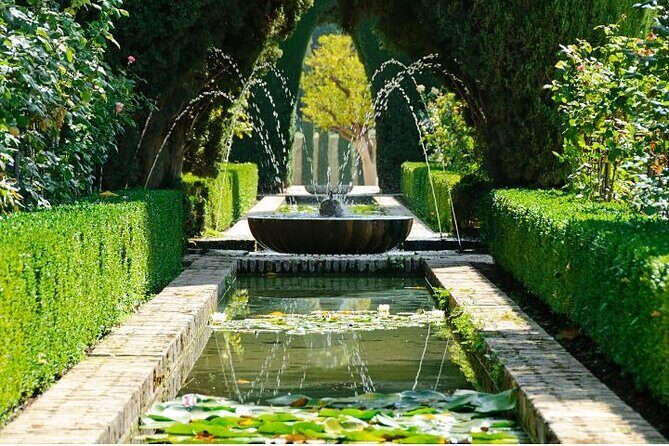
The Generalife is why many people plan this tour, and the way it’s handled here is smart. You start on the Cerro del Sol hill, with explanations tied to both Nasrid and Christian garden interpretations.
You’ll see the Nasrid orchards, then the Christian labyrinth gardens of the Generalife. The guide explains the flora and the fruits produced in the orchards. That plant-focused talk is more useful than it sounds. When you know what’s being grown and why, the gardens stop being just visual—they become functional.
Then you go to the Generalife Palace and learn about its physical communication with the city of the Alhambra. In other words, you’re seeing the retreat as part of the wider system, not as an isolated postcard.
The tour then moves through a sequence of patios, which is where Generalife really comes alive:
- Patio de Polo
- Patio de la Guardia
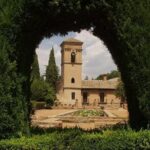
- Patio de la Acequia, where you’ll see the summer house of the Sultan
- Patio de la Sultana, noted for a cypress and tall gardens
You’ll exit through the Paseo de las Adelfas. That exit route feels like a finishing sentence: you leave the gardens with your eyes ready for the next view and with the story still fresh.
Time here is about 30 minutes, and the tour includes admission for the Generalife gardens. If you’ve only ever seen the Alhambra in photos, this is the section where you’ll feel the place in your body—shade, water sounds, and the way walking paths gently change the mood.
Stop 5: Palacio El Partal’s portico, pool, and garden punctuation
After Generalife, you’ll get a short visit to Palacio El Partal. This is only about 10 minutes, but it’s not just filler. It’s the kind of stop that gives the itinerary variety: you get a different kind of architecture and a different “garden frame” around water.
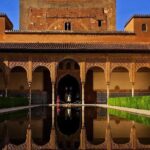
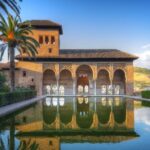
You’ll see the portico, the pool, and the gardens that surround the palace. Even if you’re tired from earlier walking, Partal works as a palate cleanser. It’s a place where the design is all about proportion and calm.
If you’re the type who likes to compare spaces, you’ll probably notice how Partal feels more like a landscaped composition, while Generalife feels like a lived-in retreat system with orchard and patio logic.
Price and ticket value: what you’re really paying for
At $47.94 per person for roughly two hours, the price looks reasonable when you line it up against what’s actually included.
You get entrance coverage for the Gardens of Generalife and Alcazaba, and you also get access tied to the listed stops (with specific stops marked as ticket included). On top of that, you get an audio system, which is a quiet but real quality-of-life upgrade on a site where guides compete with crowds and stone echoes.
The value isn’t just the admissions—it’s the routing. You’re seeing five major areas, and they’re ordered to explain how the Alhambra works as a fortified city, a later-reworked complex, and a living landscape of water and cultivation. If you’re visiting for the first time, that context is what saves you from wandering in circles.
The main trade-off is time. Two hours is tight, so you won’t have long, quiet hours to sit and write postcards. If you’re a slow explorer who likes to spend 45 minutes in one courtyard, you might want to add independent time after the tour.
Timing tips: the 10:30 slot and how to handle real-world delays
This tour is often booked ahead, with an average booking window listed at 31 days in advance. That’s a good sign that the best time slots go first.
One practical tip from real experience: if the 10:30 departure is available, it can help reduce crowd pressure compared with later day arrivals. In September especially, mornings can feel more manageable. That said, schedules on this kind of site can shift.
If your day is tightly planned, treat the start time as a goal, not a guarantee. The same tour has shown up late in at least one case, moving the start later than expected. You’ll feel the impact more if you’re coordinating dinner reservations, a train, or a second booking.
My advice: keep your next commitment flexible, and do your photo planning before the tour rather than after the tour.
Who this tour suits best (and who should think twice)
This tour is a good match if you:
- want guided explanations rather than self-guided guessing
- like learning how the Alhambra’s parts connect (defense → city life → garden retreat)
- appreciate an audio system so you can hear explanations on crowded walkways
- prefer an itinerary that doesn’t require you to mentally map every turn
It’s not recommended for people with reduced mobility, which is important because of the terrain and the site’s layout. If you’re bringing a baby, note that babies cannot access strollers; the instruction says only carrying backpacks. If you need stroller access, you’ll want to think about alternatives before you book.
Service animals are allowed, and the tour is designed so that most travelers can participate, which is a positive baseline.
Should you book this Alhambra tour?
Book it if this is your first Alhambra visit and you want the strongest “understanding per minute” route. You’ll cover Alcazaba, Generalife, Carlos V, and the Calle Real corridor, with the story told in a way that helps you look at details without getting lost. The tour is also very well liked overall, with a 4.8/5 rating and 96% recommending it, which fits the idea that people leave feeling they got their money’s worth.
Skip it (or consider a different format) if you need a slow, unhurried visit with long breaks, or if mobility is a serious concern for you. In that case, the time structure and terrain will likely feel restrictive.
If you want a practical, guided path that makes the Alhambra feel like a connected place, this is a strong choice.
FAQ
What is the duration of the tour?
The tour lasts about 2 hours (approx.).
Is the tour offered in English?
Yes, it is offered in English.
Which areas of the Alhambra are included?
The tour covers Alcazaba, the Palace of Carlos V, Calle Real de la Alhambra, Generalife, and Palacio El Partal.
Are any tickets included?
Yes. The experience includes entrance for the Gardens of Generalife and Alcazaba, and admission is also listed as included for Palace of Carlos V and Generalife stops. Calle Real de la Alhambra is listed as ticket free during the tour.
Where do I meet the guide?
You meet at the Alhambra Meeting Point | Tienda de Souvenirs y Alhambra tours, at P.º de la Sabica, 1, Local, Centro, 18009 Granada.
Where does the tour end?
It ends next to the Palace of Charles V at C. Real de la Alhambra s/n, Centro, 18009 Granada.
Is an audio system included?
Yes. An audio system is included.
How big are the groups?
The tour has a maximum of 30 travelers.
Is it suitable for people with reduced mobility or strollers?
It is not recommended for people with reduced mobility. Also, babies cannot access strollers and can only use carrying backpacks.
Can I cancel or change my booking?
No. The experience is non-refundable and cannot be changed for any reason.