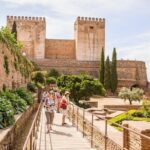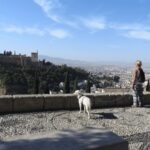
Skip the long Alhambra hassle. This tour is designed to get you into the main Alhambra areas fast, with a private guide and group-entry access so you do not burn time in separate lines. I especially like how it stitches together the story across different spaces, not just one palace or one view, and how the guide keeps the details clear while you walk.
The one thing to keep in mind is timing. Alhambra visiting hours can shift based on availability, and if official access is not there for your date, the operator may cancel and refund you. That is rare, but it is the main reason to keep a flexible day.
In This Review
- Key highlights you should care about
- Why this Alhambra tour feels faster than doing it alone
- Nasrid Palaces: the jewel rooms where Granada’s rulers flexed power
- El Mexuar: the oldest palace feel
- Comares Palace: where the pond turns architecture into drama
- Alcazaba towers: fortress views that make Granada look different
- Torre del Cubo: Darro Valley and the Albaicín/Sacromonte mix
- Torre de las Armas: big views toward cathedral and La Vega
- Torre de la Vela: the 360-degree payoff
- Generalife: gardens, water engineering, and the Sultan’s escape
- Generalife Palace: rooms for rest and Ramadan retreat
- Generalife Gardens: Acequia Real watering the whole scene
- Palace of Charles V: the Renaissance interruption you cannot ignore
- Pedro de Machuca and the circular-inside effect
- The 64 columns and the Puerta de los Carros trick
- Price and value: what you are really paying for
- Who this tour suits best (and who should consider alternatives)
- Small logistics that can save your day
- Should you book this Alhambra tour?
- FAQ
- How long does the tour last?
- Which parts of the Alhambra are included?
- Does this tour avoid individual queues?
- Where do I meet, and where does it end?
- Is there an audio system?
- Will the tour time change?
- What is the cancellation and refund policy?
Key highlights you should care about
- No individual lines: group-entry access with your guide
- Four big zones covered: Nasrid Palaces, Alcazaba, Generalife, and Charles V Palace
- Town views built in: multiple tower stops across Granada from above
- Sights with meaning: stories tied to rooms, ponds, ceilings, and irrigation
- Small-group feel: max 30 travelers, plus an audio system for groups of 7+
Why this Alhambra tour feels faster than doing it alone
Alhambra is the kind of place where time can slip away fast. The big win here is the group entry approach: you avoid the whole individual-queue headache and instead move through the monument with a guide. The tour runs about 3 hours (sometimes up to 3–4 hours), which is a sweet spot for first-time visitors who want “see the important stuff” without turning the day into a marathon.
Another practical plus: you get an organized path through the complex, and that matters because the Alhambra layout can feel like a maze—lots of courtyards, stairs, and shifts in elevation. When someone is guiding you, you spend your energy looking at things, not figuring out where to go next.
Logistics are simple but worth knowing. You meet at Patronato de la Alhambra y el Generalife, along P.º del Generalife, Centro, 18009 Granada. You finish somewhere else (the ticket redemption point is Cam. Viejo del Cementerio, 5B). So, plan to end your outing near that area rather than assuming you will end exactly where you started.
You can also read our reviews of more guided tours in Granada
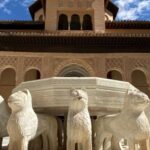


Nasrid Palaces: the jewel rooms where Granada’s rulers flexed power
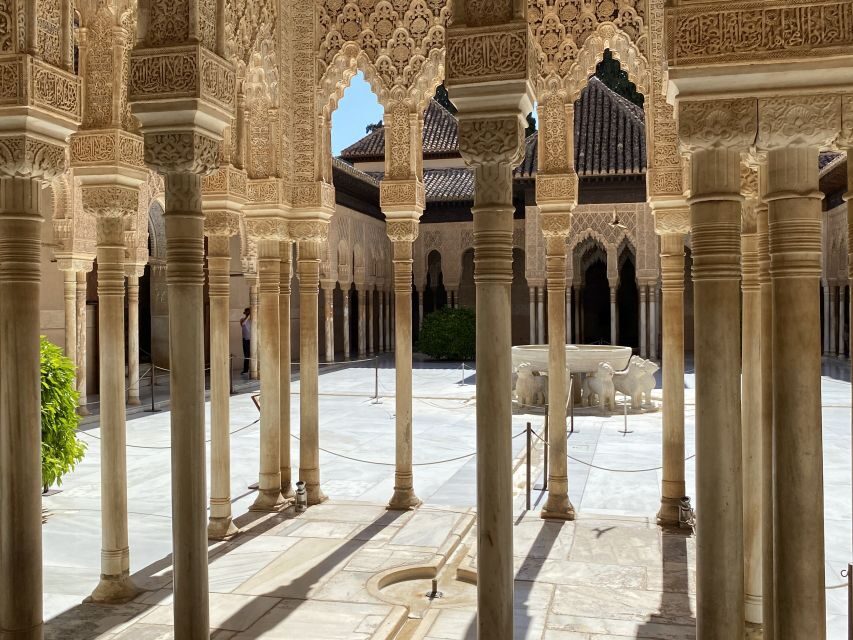
The tour’s first major stop is the Nasrid Palaces, the heart of the Alhambra’s famous artistry. You start with the oldest palace area and then work forward through the spaces where design and symbolism do a lot of the talking. This is where you notice how the builders mixed light, water, and pattern to create emotion—cool, calm, and slightly theatrical all at once.
El Mexuar: the oldest palace feel
El Mexuar is a great place to start because it has that “layered over time” quality. It was built by Ismail I and is described as the oldest part of the complex. You also get the sense that later rulers kept adjusting and improving spaces—more modifications than other palace areas. The guide’s explanations can make these changes easier to “see,” not just read about later.
You’ll hear about the oratory connected with views back toward the Albaicín neighborhood. Even if you are not hunting for perfect photos, it helps you understand the palace wasn’t sealed off from the city—it was meant to sit above it.
Comares Palace: where the pond turns architecture into drama
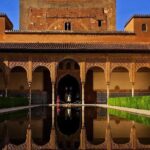
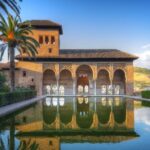
Next comes the Comares Palace, built by Yusuf I. The big visual moment here is the 46-meter tower and the way it reflects in a large pond. The marble floor matters too: it helps the whole space feel polished and ceremonial, like you are walking across a stage.
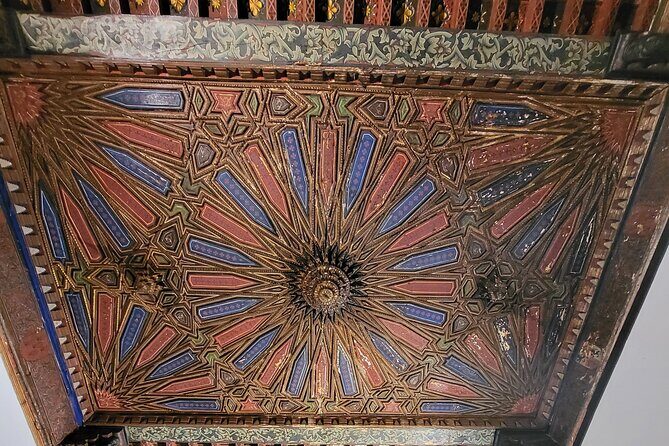
The guide focuses on the Hall of the Ambassadors and the idea that this is where Nasrid power was concentrated, including the Sultan’s throne area. Then there’s the ceiling—described as featuring a spectacular representation of the 7 heavens and the paradise of Islam. You do not need to be an art historian to get it. When someone tells you what you are looking for, you start to read the symbolism.
If you only have a short time in the Alhambra, the Nasrid Palaces are the place to prioritize. They are the reason many people travel here in the first place.
Alcazaba towers: fortress views that make Granada look different
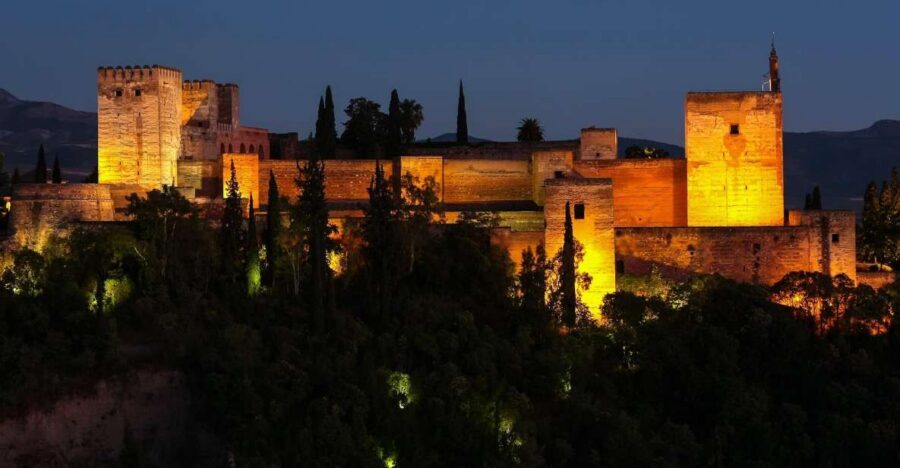
After the palace interiors, the Alcazaba brings you back outside—thick walls, stronger defensive vibes, and wide-open sightlines. This is the first part of the Alhambra built by Mohamed I Al-hamar in the early 13th century. Think of it as the Alhambra’s backbone: protective, practical, and commanding.
You access three key towers, and each one frames Granada in a new way.
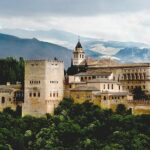


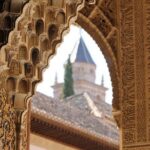
Torre del Cubo: Darro Valley and the Albaicín/Sacromonte mix
From the Torre del Cubo, you look toward the Darro Valley. The payoff is the view over the Albaicín and Sacromonte. If you have not spent time in those neighborhoods yet, this is a fast way to “locate” them in your mind. It’s also a reminder that the Alhambra was never just about beauty—it was a command center watching over territory.
Torre de las Armas: big views toward cathedral and La Vega
The Torre de las Armas is more about breadth. You get views of the Cathedral, the center of Granada, and La Vega. I like this stop because it connects your palace experience to the modern city around it. The Alhambra doesn’t float in isolation. It sits over Granada like a high vantage point that still feels strategic.
Torre de la Vela: the 360-degree payoff
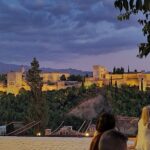
Then you get the classic one: Torre de la Vela. It is the most famous tower and offers 360º views across the city, with a panoramic look that can stretch toward the Sierra Nevada. Even if the sky is not perfect, the scale lands. You start to see the Alhambra the way a ruler would: as control, not just a monument.
After the towers, there is a quieter moment in the center of the fortress. The military neighborhood is where around 13 families lived, and you can still see foundations of houses and ruins connected with what were once royal baths. This helps the whole fortress feel human, not just military.
Generalife: gardens, water engineering, and the Sultan’s escape
If you want a mental reset after palace symbolism and fortress stone, Generalife delivers. It is famous for surviving Nasrid garden design in Europe, and the Arabic name is said to mean Garden of the Architect. That meaning comes through when you notice how purposeful the plantings and water flows are.
You get two elements here: the Generalife Palace and the Generalife Gardens.
Generalife Palace: rooms for rest and Ramadan retreat
The palace was used as a vacation residence for the Sultan. The guide also connects the space to his retirement during Ramadan. That detail matters because it turns the rooms into more than decorative stops. You can picture these spaces as private and reflective, not just ceremonial.
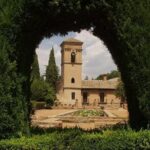
Inside, you visit spaces named Patio de la Alberca, Patio de la Sultana, Salón Regio, and the Mirador de Ismail. Even without memorizing every name, the guide’s job is to show you how courtyards, patios, and viewpoints work together to create calm.
Generalife Gardens: Acequia Real watering the whole scene
Then the gardens: a mix of flowers, crops, and plants. What I appreciate most is the water story. The gardens are watered with the waters of the Acequia Real. Once you connect the irrigation system to the beauty you see, the place feels engineered, not accidental.
This stop is short—about 30 minutes—but it is one of the most “feel it” parts of the tour. If you care about senses (cool shade, scents, the sound of water if present, and the visual calm), this is where the Alhambra slows down.
Palace of Charles V: the Renaissance interruption you cannot ignore
Just when you think you have fully settled into the Nasrid world, the Palace of Charles V appears as a bold Renaissance-style interruption sitting inside the Nasrid palace city. It was ordered by Emperor Charles V, and it was designed as a prelude to the Nasrid Palaces. That idea is interesting because it frames the palace not as an isolated artifact, but as part of a shifting timeline.
Pedro de Machuca and the circular-inside effect
The palace is associated with Pedro de Machuca, trained in Italy with names like Michelangelo and Raphael. His son Luis de Machuca continued after his death. You might not clock the architectural background in a single pass, but the description of the palace structure is memorable: it is circular inside and square on the outside.
That design choice creates a surprising spatial feel. Inside, you sense a ring of columns and forms. Outside, it reads as solid and controlled. It is a physical lesson in contrast.
The 64 columns and the Puerta de los Carros trick
The palace has 64 columns, and the tour explains a practical detail that is easy to miss if you are just looking: builders had to open a door in the Arab wall called the Puerta de los Carros so they could bring in the columns and materials.
That is the sort of detail that makes you respect the engineering effort. It also connects eras—Renaissance construction literally requiring a breach (and then a solution) within an existing Arab wall layout.
This is the final stop and the shortest—about 15 minutes. Give it a quick scan with the guide’s explanation in your head, and you will walk away with a clearer sense of how Spain layered cultures across the same ground.
Price and value: what you are really paying for
At $100.94 per person, this is not a bargain tour. But value at the Alhambra is not just about cost—it is about what you trade away (time in line, confusion, and missed context).
Here’s what the price covers: entrance access to Alcazaba, Generalife, Charles V Palace, and the Nasrid Palaces, plus a tour guide, and an audio system for groups of 7+. Tips are not included.
You also get group entry that helps you avoid individual queues. For many people, that single benefit is worth a lot. Alhambra days can get stressful if you keep getting pushed around by timed entry systems. This tour is built to reduce that friction.
A final value note: the tour is described as typically booked about 58 days in advance on average. That tells me most people plan ahead to lock a workable entry time. If you show up with a loose plan, you might still get access—but you take on more uncertainty.
Who this tour suits best (and who should consider alternatives)
This experience fits well if:
- You have limited time in Granada and want the big Alhambra zones in one go
- You dislike spending your energy standing in lines
- You prefer your history and symbolism explained in plain language while you walk
- You want views plus interiors, not just one or the other
It may be less ideal if:
- You want long, slow self-guided wandering where you can stay in one courtyard for ages
- You are planning a very tight schedule with no flexibility at all (because visiting hours can change due to availability)
One more real-world note: there is an occasional risk of cancellation if official Alhambra access is not available for your date. In one case shared for this type of experience, the reservation was canceled because the Patronato did not have tickets available, and the full payment was refunded. That does not mean it will happen to you—but it is why I recommend keeping one backup option for the day.
Small logistics that can save your day
A few practical things to know so you do not lose time:
- Arrive early at Patronato de la Alhambra y el Generalife. Your day starts there, and the tour ends in a different area.
- Plan for a 3-hour experience, with the possibility it stretches toward 3–4 hours depending on schedule availability.
- The operator notes that visiting hours may change, and you will be informed if that happens.
- Service animals are allowed, and the meeting area is near public transportation.
- If you are in a group of 7+, you get an audio system for clearer guide communication.
And yes, tips are not included. If you want the guide to remember your group nicely after a long day of explaining the seven heavens to everyone, have some cash ready.
Should you book this Alhambra tour?
My take: book it if you want the full Alhambra experience without the line stress. You get the Nasrid Palaces (including the dramatic Comares setup and the Hall of the Ambassadors), the Alcazaba tower views, the Generalife gardens and palace retreat, and the Renaissance contrast of Charles V—all in one guided sweep.
The main downside is not the tour content. It is scheduling risk. If Alhambra availability shifts, the tour time can change and, in the worst case, the slot can be canceled with a refund. If your trip has some breathing room, that risk is manageable.
If your priority is to spend your energy absorbing the place instead of managing the logistics, this is a strong way to do it.
FAQ
How long does the tour last?
It runs about 3 hours on average, and it can last between 3 and 4 hours depending on schedule availability.
Which parts of the Alhambra are included?
The included areas are Alcazaba, Generalife, the Nasrid Palaces, and the Palace of Charles V.
Does this tour avoid individual queues?
Yes. The tour is described as having group entry and avoiding waiting for individual lines.
Where do I meet, and where does it end?
You start at Patronato de la Alhambra y el Generalife, P.º del Generalife, Centro, 18009 Granada. The tour ends in a different location (the ticket redemption point is Cam. Viejo del Cementerio, 5B, Centro, 18009 Granada).
Is there an audio system?
There is an audio system for groups of 7 Pax or more.
Will the tour time change?
It might. Visiting hours may change due to availability, and you are supposed to be informed if that happens.
What is the cancellation and refund policy?
You can cancel for a full refund if you cancel at least 24 hours before the experience’s start time. Free cancellation is available up to that point.